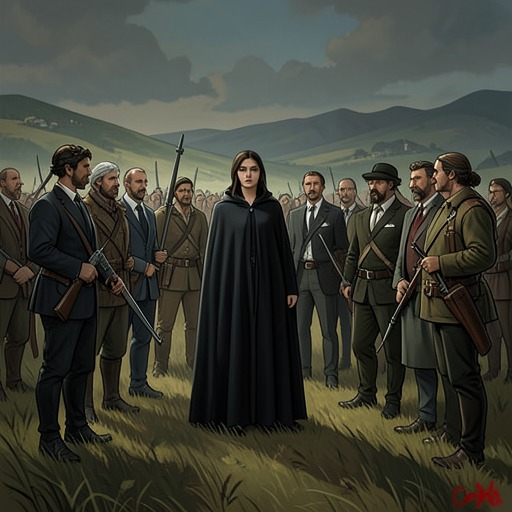
Jeyne Arryn
Fire & BloodJeyne Arryn, called the Maiden of the Vale, was a powerful ruler whose support helped turn the Vale toward Rhaenyra Targaryen during the Dance of the Dragons. Her alliance was negotiated on terms she chose: she recognized Rhaenyra as the rightful queen, but also demanded dragonriders for the Vale. Later, as a regent in King’s Landing, Jeyne remained a significant political presence; her death in Gulltown and choice of a distant cousin as heir brought the competing claims within House Arryn into open conflict.
Identity and Early Rule
Jeyne was five-and-thirty when Jacaerys Velaryon came to the Eyrie to seek her support, making her twenty years older than the young prince. She had never married and had ruled the Vale since her father and elder brothers were killed by the Stone Crows of the hills when she was three. Her position was therefore not a temporary inheritance awaiting a husband: she had governed in her own right for decades by the time the civil war tested her authority.
That authority had not gone unchallenged within her family. Jeyne told Jacaerys that her kin had tried three times to replace her, and identified her cousin Ser Arnold Arryn as a persistent opponent of women’s rule. At the time of their meeting, Arnold was imprisoned in one of the Eyrie’s sky cells. Jeyne’s experience of repeated challenges made the question of Rhaenyra’s claim more than an abstract dispute over succession. She saw women’s political rights as vulnerable to the same arguments that had been used against her.
Alliance with Rhaenyra
During the succession crisis, Jeyne was an important potential ally for either side. Otto Hightower’s party recognized that the Vale might support Rhaenyra partly because Jeyne herself was a woman ruler whose rights could be put in doubt if the princess were displaced. Daemon Targaryen likewise hoped that the Maiden of the Vale would bring the Eyrie to Rhaenyra’s side. The Vale’s support was not guaranteed, however; Jeyne would decide what the alliance required.
Jacaerys arrived at the Eyrie on Vermax. Jeyne affirmed that Rhaenyra was the rightful queen and invoked their shared position as women exercising authority in a world dominated by men. She also noted that Rhaenyra was related to her through her mother, an Arryn. But she did not offer support without conditions. Though armies had repeatedly failed against the Bloody Gate and the Eyrie was considered impregnable, Jeyne said that Jacaerys’s arrival by dragon had made her feel powerless. She wanted dragonriders sent to the Vale so that it would not be left exposed to the same advantage.
Jacaerys agreed to her request. Jeyne then knelt before him, and her warriors swore their swords. Her pledge illustrates both the value and the limits of dynastic alliance: kinship and shared political interests brought her toward Rhaenyra, while the presence of dragons shaped the terms on which she would commit the Vale. The support she secured later included aid by sea when snow closed the mountain passes.
The Vale’s Contribution to the War
After leaving the Eyrie, Jacaerys flew north across the Fingers and the Bite. He stopped at Sisterton, where Lords Borrell and Sunderland pledged the support of the Three Sisters, then continued to White Harbor and Winterfell. The Vale’s agreement was thus part of a wider diplomatic journey to gather allies for Rhaenyra, but Jeyne’s promise was especially consequential: her forces could reach the queen’s cause by sea even when winter made the land routes impassable.
By Maiden’s Day in 130 AC, the Vale had acted on its pledge. Jeyne sent men by sea to join Rhaenyra’s forces, while ships also brought warriors from White Harbor under Lord Desmond Manderly’s sons, Medrick and Torrhen. At that moment Rhaenyra’s power was growing as Aegon II’s diminished. The Vale’s support formed part of that change in the balance of the war, alongside House Velaryon’s command of the waves and the weakening of the Triarchy.
Later, after Rhaenyra had fled King’s Landing, Jeyne again offered assistance. Writing from her winter castle at the Gates of the Moon, she promised aid but explained that snow had shut the mountain passes. If House Velaryon sent ships to Gulltown, her army could be dispatched to Duskendale; otherwise she would have to hire vessels from Braavos and Pentos, which required money. Rhaenyra had neither ships nor gold after sending Corlys Velaryon to the dungeons and fleeing the capital. Jeyne’s offer was real, but the conditions of transport and finance exposed how the queen’s remaining allies could not help without resources she no longer possessed.
Regency and Political Influence
After the war, Jeyne joined the council of regency established to govern for the child king Aegon III. The appointment placed her among the realm’s senior political authorities at a moment when so many lords had died that women governed in the place of husbands, brothers, and fathers. The regency brought together powerful figures from across the kingdoms, including Corlys Velaryon, Lord Leowyn Corbray, and Torrhen Manderly. Jeyne’s presence reflected her standing as a ruler in her own right as well as her importance to the settlement that followed the Dance.
Her service at court was interrupted by danger in her own domain. Bands of wildlings from the Mountains of the Moon descended upon the Vale to raid and plunder. Jeyne left King’s Landing and sailed for Gulltown to defend her lands and people. Her departure reduced the regency from seven members to five, as Lord Caron also returned to the Dornish Marches amid unrest there. The shift left Corlys Velaryon as the most influential regent and, according to the account, the only man the young king seemed willing to trust.
Death and Succession Dispute
Jeyne died in 134 AC, aged forty, at Gulltown. A cold that had settled in her chest proved fatal while she was at the Motherhouse of Maris, on the stony island in the harbor. She died in the arms of Jessamyn Redfort, described as her dear companion. Before her death, Jeyne dictated a testament naming her cousin Ser Joffrey Arryn as her heir. He had served her loyally for ten years as Knight of the Bloody Gate and had defended the Vale against the wildlings of the hills.
The choice immediately reopened the succession question that had shadowed Jeyne’s rule. Joffrey was only her fourth cousin by degree, while Ser Arnold Arryn was her first cousin. Arnold had twice rebelled against Jeyne and was now considered mad after years in the Eyrie’s sky cells and the dungeons beneath the Gates of the Moon. His son Ser Eldric Arryn, however, was sane, ambitious, and capable of pressing the family claim. Many Vale lords supported Eldric, arguing that established inheritance laws could not be set aside by the choice of a dying woman. A third claimant, Isembard Arryn of the wealthy Gulltown branch, used money to win lesser lords and brought sellswords across the Narrow Sea.
Jeyne’s final testament therefore did not end the political contest around her inheritance. It made that contest explicit: her own selection of a loyal servant confronted the claims of closer blood relatives and the insistence that customary law should prevail over her judgment. Across her life, Jeyne had maintained rule despite challenges from her kin, chosen the terms of a major wartime alliance, and served on the council governing a kingdom after civil war. In death, the dispute over her heir showed how precarious a woman’s authority remained, even after decades of rule.